

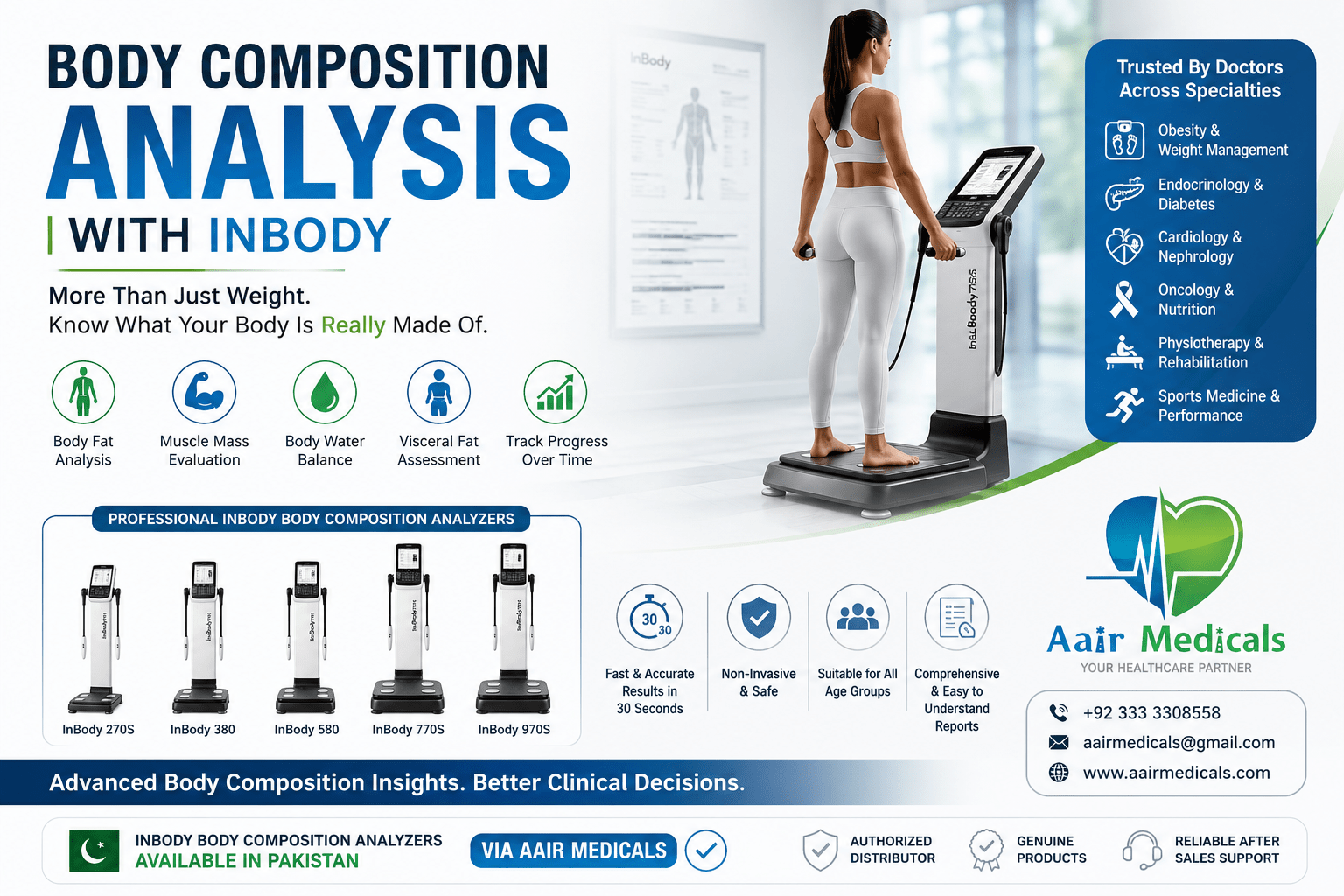
Body Composition Analysis: Why InBody Is Becoming an Essential Tool in Modern Healthcare
Body composition analysis is changing the way healthcare professionals assess patients. Instead of looking only at body weight or BMI, doctors can now obtain a much more detailed understanding of a patient’s body fat, skeletal muscle, lean body mass, visceral fat and body water.
Among the leading technologies used for professional body composition assessment, InBody body composition analyzers are widely used in hospitals, clinics, weight-management centers, rehabilitation facilities, sports medicine centers, nutrition practices and research institutions.
For healthcare professionals in Pakistan, InBody body composition analyzers are available through AAIR Medicals, providing access to professional InBody solutions for medical, clinical, rehabilitation and wellness applications.
What Is Body Composition Analysis?
Body composition analysis is the measurement of the different components that make up a person’s body.
A conventional weighing scale tells you only one thing:
How much does the patient weigh?
Body composition analysis provides a much more detailed picture:
- How much body fat does the patient have?
- How much skeletal muscle does the patient have?
- How much lean body mass is present?
- Where is muscle distributed throughout the body?
- How much visceral fat is present?
- What is the patient’s total body water?
- How is water distributed between intracellular and extracellular compartments?
- Is body composition changing during treatment?
This information can be particularly valuable for doctors managing obesity, diabetes, metabolic disease, cardiovascular conditions, kidney disease, cancer, rehabilitation, aging, nutrition and sports performance.
Why Body Weight and BMI Are Not Enough
Body Mass Index (BMI) remains a useful screening tool, but it has an important limitation:
BMI does not distinguish between muscle and fat.
Consider two patients who both weigh 90 kg and have the same height.
One patient may have:
- High skeletal muscle mass
- Relatively low body fat
- High physical activity
The other may have:
- Low muscle mass
- High body fat
- High visceral adiposity
- Low physical activity
Their BMI could be identical, but their body composition and potentially their health risks can be very different.
This is why body composition analysis can complement BMI, waist circumference, laboratory investigations, clinical examination and other established medical assessments.
What Is an InBody Test?
An InBody test is a body composition assessment based on Bioelectrical Impedance Analysis (BIA).
InBody professional systems use multi-frequency BIA technology and direct segmental measurements to assess body composition. Depending on the model, the system can provide information about:
- Body weight
- Body fat mass
- Percent body fat
- Skeletal muscle mass
- Lean body mass
- Total body water
- Intracellular water
- Extracellular water
- ECW/TBW
- Segmental muscle distribution
- Segmental fat distribution
- Visceral fat
- Basal metabolic rate
- Phase Angle and other advanced parameters
The exact measurements available depend on the particular InBody model.
The current professional InBody range includes systems such as the InBody 270S, 380, 580, 770S and 970S.
How Does InBody Measure Body Composition?
During an InBody test, the patient stands on the device and holds the hand electrodes.
A very small electrical current passes through the body.
Different tissues conduct electrical current differently because they have different amounts of water and electrolytes.
The device measures electrical impedance and uses these measurements to estimate body composition.
One of the advantages of the InBody approach is that testing is:
- Non-invasive
- Fast
- Simple
- Repeatable
- Radiation-free
- Suitable for routine monitoring
For example, the InBody 770S is designed to perform body composition and body-water analysis quickly, with InBody describing approximately 30-second testing.
Why Is InBody Important for Doctors?
The real value of body composition analysis is not simply obtaining a body-fat percentage.
Its major clinical advantage is the ability to measure changes over time.
A doctor can establish a baseline:
Baseline assessment → Treatment → Follow-up assessment → Compare results → Adjust treatment
For example, a patient undergoing a weight-management program may lose 10 kg.
A weighing scale tells the doctor:
“The patient lost 10 kg.”
Body composition analysis can provide a more detailed picture:
“The patient’s body fat decreased while skeletal muscle was maintained.”
That is considerably more useful when evaluating the quality of weight loss.
Clinical Applications of InBody Body Composition Analysis
One of the most important advantages of InBody is its wide range of potential applications across medical specialties.
It is not only a device for gyms or weight-loss clinics.
InBody technology can be relevant to numerous healthcare fields.
1. Obesity Medicine and Weight Management
Obesity management is one of the most important applications of body composition analysis.
Traditional weight management often focuses on:
“How much weight did the patient lose?”
A more useful question is:
“What type of weight did the patient lose?”
During weight loss, changes may occur in:
- Body fat
- Skeletal muscle
- Lean body mass
- Body water
InBody testing can help monitor these changes over time.
This can be particularly useful for patients undergoing:
- Diet and lifestyle programs
- Exercise programs
- Medical weight management
- Pharmacological weight management
- GLP-1-based weight-management programs
- Bariatric surgery
- Post-bariatric follow-up
For obesity specialists and endocrinologists, body composition analysis can therefore provide an additional objective measurement alongside weight, BMI, waist circumference and laboratory investigations.
2. Endocrinology and Diabetes
Diabetes and metabolic disorders are strongly associated with body composition and adiposity.
An endocrinologist may want to monitor not only a patient’s weight but also:
- Body fat percentage
- Fat mass
- Skeletal muscle mass
- Visceral fat
- Lean body mass
- Body water
InBody identifies diabetes and metabolic health among its medical application areas.
For endocrinology practices, body composition analysis can therefore become part of a broader patient-monitoring strategy alongside:
- HbA1c
- Blood glucose
- Lipid profile
- Blood pressure
- Waist circumference
- Clinical history
- Lifestyle assessment
3. Cardiology
Body composition can also be relevant in cardiovascular medicine.
Excess adiposity is associated with cardiometabolic risk, while changes in body water can be clinically relevant in selected cardiovascular patients.
Depending on the InBody model, doctors can obtain information regarding:
- Total body water
- Intracellular water
- Extracellular water
- ECW/TBW
- Lean body mass
- Body fat
- Segmental composition
This information can complement conventional cardiac evaluation.
InBody should not replace echocardiography, laboratory investigations, clinical examination or other established cardiovascular assessments.
Instead, it can provide an additional quantitative measurement of body composition and fluid distribution.
4. Nephrology and Dialysis
Body-water analysis can be particularly relevant in nephrology.
Fluid management is a critical part of care for many patients with kidney disease, particularly patients undergoing dialysis.
Advanced InBody systems can provide measurements relating to:
- Total body water
- Intracellular water
- Extracellular water
- ECW/TBW
- Segmental water distribution
- Body composition
InBody’s body-water systems are specifically designed for applications including dialysis and nutritional support. AAIR Medicals also offers InBody systems designed for body-water analysis.
For nephrologists and dialysis centers, these measurements can provide additional quantitative information that may support clinical assessment and longitudinal monitoring.
5. Oncology
Cancer and its treatment can be associated with significant changes in:
- Muscle mass
- Fat mass
- Nutritional status
- Hydration
- Functional capacity
A patient can experience substantial muscle loss without dramatic changes in body weight.
This makes body composition assessment particularly interesting in oncology and supportive care.
Serial body composition measurements may help clinicians monitor changes during:
- Cancer treatment
- Nutritional intervention
- Rehabilitation
- Recovery
Advanced parameters such as Phase Angle are also being investigated in a variety of clinical populations.
6. Bariatric Surgery
Body composition analysis can be valuable before and after bariatric surgery.
Before surgery, it can establish a baseline for:
- Body fat
- Muscle mass
- Lean body mass
- Visceral fat
- Segmental composition
After surgery, serial testing can help monitor changes in body composition during weight reduction.
Instead of monitoring only:
Weight ↓
the clinical team can evaluate:
Fat mass ↓ + muscle mass maintained
This can provide a more informative picture of the patient’s progress.
7. Physiotherapy and Rehabilitation
Body composition analysis can be especially useful in rehabilitation.
Patients recovering from:
- Orthopedic surgery
- Sports injuries
- Prolonged immobilization
- Neurological conditions
- Muscle weakness
- Musculoskeletal injuries
may experience significant changes in muscle mass.
Segmental analysis can help clinicians evaluate differences between:
- Right arm
- Left arm
- Trunk
- Right leg
- Left leg
This can provide objective information alongside conventional rehabilitation assessments such as:
- Muscle strength
- Range of motion
- Gait
- Functional capacity
- Exercise tolerance
AAIR Medicals also offers InBody products used in physiotherapy and rehabilitation applications.
8. Geriatrics and Sarcopenia
As people age, preservation of muscle mass becomes increasingly important.
An older person may have a relatively normal body weight while experiencing:
Loss of muscle + increase in body fat
This can make body composition assessment particularly useful in geriatric care.
InBody measurements can provide information about:
- Skeletal muscle mass
- Lean body mass
- Segmental muscle distribution
- Body fat
- Body fat percentage
However, body composition alone should not be used to diagnose sarcopenia. Muscle strength and physical performance are also important components of clinical assessment.
9. Sports Medicine
Athletes require a different approach to body composition than the general population.
The goal is not simply:
“Lose as much weight as possible.”
The goal is to optimize:
Muscle + Fat + Performance + Recovery + Health
InBody segmental analysis can help sports medicine professionals monitor:
- Skeletal muscle development
- Muscle balance
- Body fat
- Segmental differences
- Changes during training
- Rehabilitation progress
This makes InBody useful in:
- Sports medicine clinics
- Professional sports
- Athletic training
- Performance centers
- Rehabilitation facilities
10. Nutrition and Dietetics
Body composition analysis can transform the way nutrition programs are monitored.
A nutritionist or dietitian can track:
- Weight
- Fat mass
- Muscle mass
- Lean body mass
- Body water
- Segmental composition
This allows nutritional interventions to be evaluated objectively.
For example, a patient may show only a small change in body weight while simultaneously experiencing:
Fat mass ↓
Muscle mass maintained
Body fat % ↓
That can represent meaningful progress that a conventional weighing scale would not reveal.
11. Preventive Medicine and Executive Health
Body composition analysis can also be incorporated into preventive health programs.
A person may have a normal BMI but still have:
- High body fat
- High visceral fat
- Low muscle mass
- Low physical activity
Body composition assessment can therefore add another layer of information to preventive health evaluations.
It can be combined with:
- Blood pressure
- Blood glucose
- Lipid profile
- Waist circumference
- Lifestyle assessment
- Fitness assessment
- Nutrition assessment
Understanding the Main Measurements on an InBody Result Sheet
Body Fat Mass
The estimated amount of fat present in the body.
Monitoring fat mass can help assess changes during weight-management and lifestyle interventions.
Percent Body Fat
The percentage of total body weight represented by fat.
It provides information that body weight alone cannot provide.
Skeletal Muscle Mass
An estimate of skeletal muscle mass.
This measurement is particularly relevant in:
- Rehabilitation
- Sports medicine
- Geriatrics
- Obesity management
- Nutrition
- Chronic disease
Lean Body Mass
The estimated mass of the body’s non-fat components.
Segmental Lean Analysis
Provides information about lean mass distribution across different body segments.
This can be useful for identifying differences between limbs and the trunk.
Visceral Fat
Visceral fat is fat located around internal organs and is metabolically important.
InBody provides visceral-fat-related measurements on applicable models.
Total Body Water
An estimate of the total amount of water in the body.
Intracellular Water
Water located inside cells.
Extracellular Water
Water located outside cells.
ECW/TBW
The ratio of extracellular water to total body water.
Advanced body-water measurements can be particularly relevant in selected medical and research applications.
Phase Angle
Phase Angle is an impedance-derived parameter that is increasingly studied in areas such as nutrition, oncology, aging and other clinical populations.
Its interpretation should always be based on the patient’s clinical context and should not be treated as a standalone diagnosis.
Which InBody Machine Is Suitable for a Medical Practice?
InBody offers several professional body composition analyzers, each designed for different applications and levels of assessment.
InBody 270S
The InBody 270S is a compact and portable professional body composition analyzer.
It is particularly suitable for:
- Clinics
- Nutrition practices
- Wellness centers
- Fitness facilities
- Mobile professionals
The current InBody 270S provides body composition analysis in approximately 30 seconds and is designed as a portable system.
AAIR Medicals offers the InBody 270S in Pakistan.
InBody 380
The InBody 380 is designed for professional body composition assessment and can be suitable for clinics, hospitals, nutrition practices and fitness facilities.
AAIR Medicals currently lists the InBody 380 for healthcare and professional applications in Pakistan.
InBody 580
The InBody 580 provides more advanced body composition analysis and is designed for professional health assessment.
It can be considered for:
- Medical clinics
- Weight-management centers
- Nutrition clinics
- Rehabilitation facilities
- Fitness and wellness centers
InBody 770S
The InBody 770S is a research-grade professional system with a deeper focus on body-water analysis.
It provides both body composition and body-water results and is particularly relevant to advanced clinical, research and medical applications.
AAIR Medicals offers the InBody 770S in Pakistan.
InBody 970S
The InBody 970S represents the high-end professional segment of the current InBody body composition analyzer range.
It incorporates advanced measurement technology and is designed for diverse patient populations and medical specialties.
For hospitals, research institutions and advanced multidisciplinary medical centers, the InBody 970S can be considered where comprehensive body composition assessment is required.
InBody vs a Conventional Weighing Scale
| Measurement | Weighing Scale | InBody |
|---|---|---|
| Body Weight | ✓ | ✓ |
| Body Fat Mass | ✗ | ✓ |
| Body Fat % | ✗ | ✓ |
| Skeletal Muscle Mass | ✗ | ✓ |
| Segmental Muscle Analysis | ✗ | ✓* |
| Visceral Fat | ✗ | ✓* |
| Total Body Water | ✗ | ✓ |
| Intracellular Water | ✗ | ✓* |
| Extracellular Water | ✗ | ✓* |
| ECW/TBW | ✗ | ✓* |
| Phase Angle | ✗ | ✓* |
| Body Composition History | ✗ | ✓ |
*Availability depends on the specific InBody model.
The fundamental difference is simple:
A weighing scale tells you how much you weigh. InBody helps show what that weight consists of.
How Accurate Is InBody?
Accuracy is an important consideration when selecting a body composition analyzer.
BIA is a well-established method for estimating body composition, but results can be influenced by factors including:
- Hydration
- Food and beverage intake
- Exercise
- Time of day
- Body temperature
- Patient condition
For this reason, standardized testing conditions are important when comparing results over time.
InBody uses direct segmental multi-frequency BIA technology across its professional product range and emphasizes repeatability and standardized measurement.
However, no body composition technology should be treated as a substitute for clinical judgment.
For doctors, the greatest value often comes from using the system consistently to track trends over time, rather than focusing excessively on one isolated measurement.
Is InBody Better Than BMI?
It is more accurate to say that InBody and BMI provide different types of information.
BMI is:
- Simple
- Fast
- Inexpensive
- Useful for population-level screening
But BMI cannot distinguish muscle from fat.
InBody can provide additional information about:
- Fat
- Muscle
- Lean mass
- Body water
- Segmental composition
Therefore, doctors can use BMI and body composition analysis together rather than viewing them as competing measurements.
Is InBody a Replacement for DEXA, CT or MRI?
No.
Different body composition technologies have different strengths.
DEXA, CT and MRI can provide information that BIA cannot provide in the same way.
InBody’s advantages include:
- Fast testing
- Non-invasive measurement
- No ionizing radiation
- Convenient clinical workflow
- Easy repeat testing
- Practical longitudinal monitoring
Therefore, InBody should generally be viewed as a complementary clinical assessment tool, not as a universal replacement for imaging or other diagnostic technologies.
Why Body Composition Analysis Is Becoming More Important in Modern Weight Management
Modern weight-management medicine is increasingly focused on more than simply reducing body weight.
Consider a patient who loses 12 kg.
The important clinical question is:
How much of that 12 kg was fat, and how much was lean tissue?
This question has become particularly relevant with the increasing use of structured medical weight-management programs and GLP-1-based therapies.
Body composition analysis can provide objective information that helps doctors monitor:
Fat loss + Muscle preservation + Overall body composition
This can make patient consultations more informative and help patients understand that successful weight management is about improving body composition and health—not simply achieving a lower number on the weighing scale.
Why Hospitals and Clinics Should Consider an InBody Body Composition Analyzer
An InBody system can add a quantitative measurement layer to many clinical services.
It can help a facility develop:
Baseline Assessment
Measure the patient’s body composition before treatment.
Treatment Monitoring
Repeat measurements during the intervention.
Outcome Measurement
Compare the patient’s results over time.
Patient Education
Use the result sheet to explain changes in fat, muscle and body composition.
Patient Engagement
Objective measurements can make progress easier for patients to understand.
Multidisciplinary Care
Different specialists can use body composition data according to their clinical objectives.
InBody Body Composition Analyzers Available in Pakistan
For doctors, hospitals, clinics and healthcare professionals looking for an InBody body composition analyzer in Pakistan, professional InBody systems are available through AAIR Medicals.
AAIR Medicals lists InBody among its exclusive-distributor brands and provides InBody equipment for healthcare and professional applications in Pakistan.
Available solutions include models such as:
- InBody 270S
- InBody 380
- InBody 580
- InBody 770S
- Other InBody professional systems and body-water analysis solutions
AAIR Medicals also lists InBody equipment for applications including medical clinics, hospitals, physiotherapy, nutrition, wellness and professional body composition assessment.
If you are considering purchasing an InBody machine in Pakistan, the appropriate model depends on your specialty, patient volume, required measurements, clinical objectives and budget.
Why Buy InBody from AAIR Medicals Pakistan?
Choosing a body composition analyzer is not only about purchasing the equipment.
Healthcare professionals also need reliable product sourcing, technical guidance and after-sales support.
AAIR Medicals provides InBody solutions in Pakistan and lists itself as an InBody distributor.
AAIR Medicals can help healthcare professionals identify the appropriate InBody system for:
- Hospitals
- Medical clinics
- Endocrinology practices
- Obesity and weight-management centers
- Bariatric centers
- Nephrology and dialysis centers
- Physiotherapy clinics
- Rehabilitation centers
- Nutrition and diet clinics
- Sports medicine facilities
- Research institutions
- Fitness and wellness centers
For product availability, model selection and current pricing, healthcare professionals can contact AAIR Medicals directly.
Who Can Benefit from InBody Body Composition Analysis?
InBody can be particularly relevant to:
Endocrinologists
For obesity, diabetes and metabolic-health programs.
Obesity Medicine Specialists
For monitoring fat loss and lean mass.
Cardiologists
For complementary body composition and fluid assessment.
Nephrologists
For advanced body-water and composition assessment.
Oncologists
For monitoring changes in body composition and nutritional status.
Physiotherapists
For muscle and segmental assessment during rehabilitation.
Sports Physicians
For performance and rehabilitation monitoring.
Dietitians and Nutritionists
For objective monitoring of nutritional interventions.
Bariatric Surgeons
For pre- and post-operative body composition monitoring.
Geriatricians
For muscle mass and age-related body composition assessment.
Hospitals and Research Institutions
For advanced clinical and research applications.
The Future of Body Composition Analysis
Healthcare is moving from simple measurements toward personalized, data-driven patient management.
The future of patient assessment is unlikely to depend on a single number such as weight or BMI.
Instead, healthcare professionals will increasingly consider:
Fat + Muscle + Water + Metabolic Health + Function + Clinical History
Body composition analysis provides an important part of this broader picture.
As obesity, metabolic disease, aging, rehabilitation and personalized healthcare continue to receive greater attention, objective measurement of body composition is becoming increasingly relevant.
Conclusion: Look Beyond the Weighing Scale
The question in modern healthcare is no longer simply:
“How much does the patient weigh?”
The more important question can be:
“What is the patient’s body composed of, and how is it changing with treatment?”
Body composition analysis provides valuable information about body fat, skeletal muscle, lean mass, visceral fat and body water that cannot be obtained from a conventional weighing scale alone.
For physicians working in obesity medicine, endocrinology, diabetes, cardiology, nephrology, oncology, bariatric medicine, physiotherapy, rehabilitation, geriatrics, nutrition and sports medicine, an InBody body composition analyzer can become a valuable complementary tool for assessment and longitudinal monitoring.
InBody Body Composition Analyzer in Pakistan
InBody professional body composition analyzers are available in Pakistan through AAIR Medicals.
Whether you are setting up a new clinic, expanding a hospital department, establishing a weight-management program or upgrading an existing body composition assessment service, AAIR Medicals can help you select the appropriate InBody solution for your requirements.
Contact AAIR Medicals today to discuss InBody body composition analyzers, available models, pricing and delivery in Pakistan.
Frequently Asked Questions About InBody in Pakistan
What is an InBody machine?
An InBody machine is a professional body composition analyzer that uses bioelectrical impedance analysis to estimate parameters such as body fat, skeletal muscle, lean body mass and body water.
Where can I buy an InBody machine in Pakistan?
Professional InBody body composition analyzers are available in Pakistan through AAIR Medicals, which lists InBody among its exclusive-distributor brands.
Which InBody machine is best for a hospital?
The appropriate model depends on the hospital’s clinical requirements. Advanced systems such as the InBody 770S and 970S provide more extensive body composition and body-water analysis and may be appropriate for advanced clinical and research environments.
Which InBody is suitable for a small clinic?
The InBody 270S or InBody 380 can be considered for clinics that require professional body composition analysis in a compact and efficient format.
Can InBody be used for weight-loss clinics?
Yes. Body composition analysis can help weight-management professionals monitor changes in body fat, muscle mass and other body composition parameters rather than relying only on body weight.
Can doctors use InBody for diabetes?
InBody can be used as a complementary body composition assessment in diabetes and metabolic-health programs.
Can InBody be used in dialysis centers?
Advanced InBody body-water analysis systems can provide measurements related to intracellular water, extracellular water and fluid distribution and may be useful as an adjunct to clinical assessment in dialysis settings.
Does InBody measure muscle mass?
Yes. Professional InBody systems provide skeletal muscle and lean-mass measurements, with applicable models providing detailed segmental analysis.
Does InBody measure visceral fat?
Applicable InBody models provide visceral-fat-related measurements as part of their body composition reports.
How long does an InBody test take?
Many current InBody systems can perform the measurement in approximately 30 seconds, although the overall patient workflow may take longer depending on preparation and consultation.
Is an InBody test safe?
BIA is non-invasive and does not use ionizing radiation. Healthcare professionals should follow the manufacturer’s instructions, contraindications and precautions for the specific InBody model.
Is InBody better than a weighing scale?
An InBody provides substantially more information than a conventional weighing scale because it estimates body composition rather than only body weight.
Is InBody the same as DEXA?
No. InBody uses bioelectrical impedance analysis, while DEXA uses X-ray-based technology. They are different technologies with different applications.
Medical Disclaimer
This article is provided for educational and professional information purposes. Body composition analysis is a complementary assessment tool and should not be used as a standalone diagnostic method. Results should be interpreted by appropriately qualified healthcare professionals together with the patient’s medical history, physical examination, laboratory investigations and other clinically indicated assessments. Measurement capabilities vary by InBody model and patient population.
About AAIR Medicals
AAIR Medicals is a medical equipment supplier and InBody distributor serving healthcare professionals and institutions in Pakistan.
AAIR Medicals provides access to professional InBody body composition analysis solutions for medical, clinical, rehabilitation, nutrition, sports and wellness applications.
Looking for InBody in Pakistan? Contact AAIR Medicals for product information, model selection, current pricing and availability.
AAIR Medicals
Rawalpindi, Pakistan
Phone: 0333-3308558 – 051-5557773
Email: aairmedicals@gmail.com
SEO Information for WordPress
SEO Title:
Body Composition Analysis & InBody in Pakistan | AAIR Medicals
Meta Description:
Learn how InBody body composition analysis helps doctors assess fat, muscle, visceral fat and body water across obesity, diabetes, cardiology, nephrology, oncology and rehabilitation. InBody available in Pakistan through AAIR Medicals.
URL Slug:
body-composition-analysis-inbody-pakistan
Focus Keyphrase:
Body Composition Analysis
Secondary Keyphrases:
- InBody Pakistan
- InBody machine Pakistan
- InBody body composition analyzer
- body composition analyzer Pakistan
- InBody test Pakistan
- InBody price in Pakistan
- buy InBody Pakistan
- InBody for doctors
- InBody for hospitals
- InBody 270S Pakistan
- InBody 380 Pakistan
- InBody 580 Pakistan
- InBody 770S Pakistan
- InBody 970S Pakistan
- body fat analyzer Pakistan
- muscle mass analyzer Pakistan
- visceral fat analysis
- body water analysis
- medical body composition analyzer
InBody, Body Composition Analysis, InBody Pakistan, Body Composition Analyzer, Obesity, Diabetes, Endocrinology, Nephrology, Cardiology, Oncology, Physiotherapy, Rehabilitation, Sports Medicine, Bariatric SurgeryInBody body composition analyzer for doctors and hospitals in Pakistan
Body Composition Analysis: Why InBody Is Becoming an Essential Tool in Modern Healthcare